
DRY NEEDLING
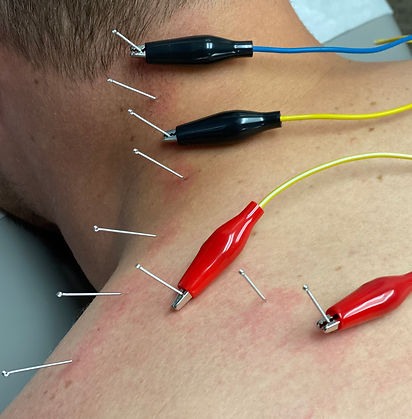
What is Dry Needling?
Dry needling is a therapeutic technique where a healthcare provider inserts thin, solid filament needles into myofascial trigger points (painful "muscle knots"). Trigger points are hyper-irritable spots in the muscle that can refer pain or cause local tenderness. They are produced in our muscles as a protective response to actual or potential muscle damage and are thought to occur in response to unaccustomed loading and repetitive low load stress. By inserting needles into these taut bands in the muscle, they force a local contraction, triggering a chemical response that produces a pain-relieving effect.
The needles may be manually stimulated (moved up and down or turned in place) and left in for approximately eight to ten minutes or attached to electrical stimulation to continuously stimulate the muscle. The goal is to stimulate underlying muscles and connective tissue to relieve pain, reduce tension, and improve your range of motion.
How does Dry Needling Work?
When the needle hits an active trigger point, it often causes the muscle to contract or twitch. This involuntary twitch "resets" the muscle, helping it to relax and release tension. Inserting the needle creates a tiny micro-lesion. This stimulates your body to increase local blood flow and send healing cells to the area.
What is the Difference Between Dry Needling and Acupuncture?
While both methods use similar, solid needles, they are entirely different practices. In dry needling, the needles are called "dry" because they do not contain or inject any medication or fluid. Dry Needling is based on modern Western medicine and anatomical/neurophysiological principles. It focuses strictly on targeting dysfunctional muscles and trigger points to relieve physical pain.
Acupuncture is rooted in Traditional Chinese Medicine and is designed to balance the body's energy flow (Qi) to treat a wide variety of systemic ailments.

What does a Session of Dry Needling Look Like?
The needles are extremely thin (about the width of a human hair). You often won't feel the needle penetrate the skin, but when it reaches the trigger point, you may feel a dull ache or a sensation like a muscle cramp. The needles may be left in the muscle anywhere from a few seconds to up to 15 minutes.
What are the Side Effects of Dry Needling?
It is normal to feel some soreness or bruising at the site for 24 to 48 hours following the treatment.

What Injuries Respond Well to Dry Needling?
Dry needling has been shown to decrease sensitization to pain, reduce muscle tone, and increase blood flow and oxygenation to the area. Athletes frequently experience tendinosis or tendonitis, from overtraining or other injury. Overcompensating due to pain or weakened areas can lead to imbalances and trigger points, causing increased pain and delayed recovery.
Dry needling can be useful in treating conditions such as tight musculature, tendinitis, tendinosis, muscle strains, and other conditions.
However, dry needling alone is not a magical cure that will heal a condition, and it must be used as a component of a broader rehabilitation approach. Thus, addressing mobility and strength deficits will always be necessary for recovery.
